
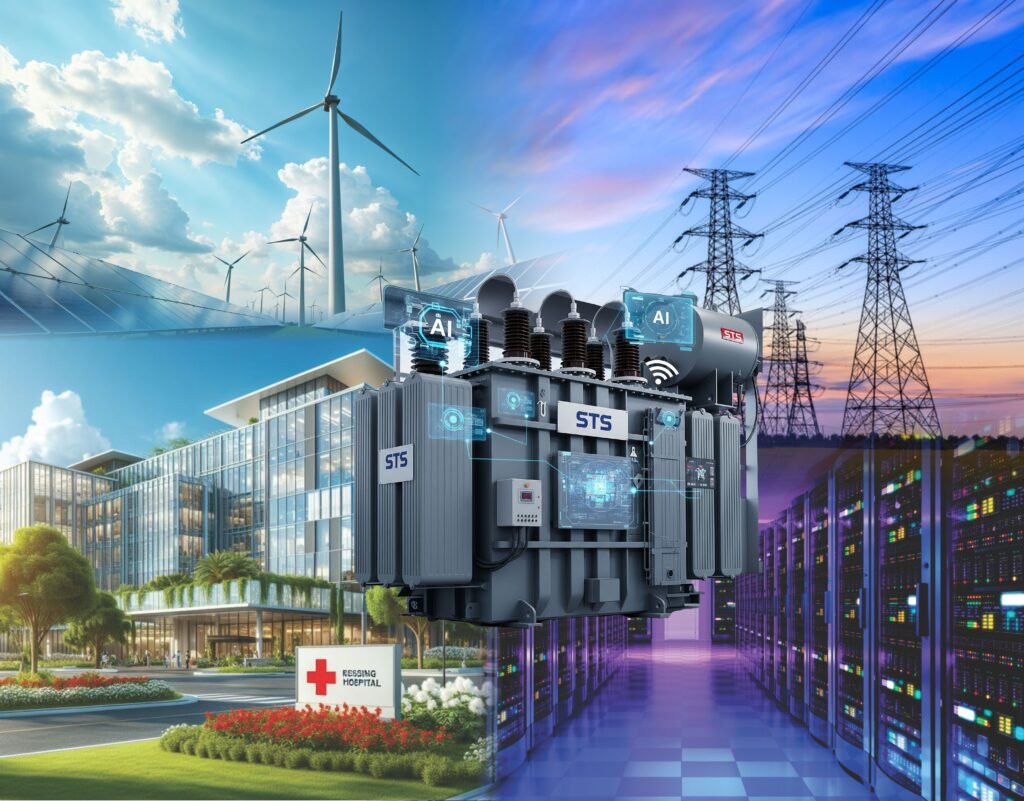
In a world where technology surrounds us, one device quietly powers almost everything we do, yet rarely gets mentioned. Every morning when your alarm rings, your lights glow, the metro runs on schedule, office coffee machines brew, and your laptop powers on, one silent machine ensures your day begins smoothly: The Transformer.
We do not see it.
We do not think about it.
But without transformers, modern life simply wouldn’t exist.
This blog explores how transformers support homes, industries, smart cities, and critical infrastructure, and why they are more essential than ever in India’s rapidly evolving power and renewable energy landscape.
Electricity’s Silent Guardian: What a Transformer Really Does
Electricity travels across long distances at extremely high voltages. This form of power is unusable and even dangerous for homes, offices, industries, metros, and data centers. The transformer plays the crucial role of converting that high voltage into stable, safe, usable power.
If electricity were water rushing out of a dam, a transformer would be the precision valve that regulates the flow. It steps voltage up for transmission, down for distribution, and maintains balance across the grid. Without this function, no electrical system could operate — from your phone charger to heavy industrial machinery.
The Hidden Network That Makes Urban Life Possible
Transformers are present everywhere in a city — at street corners, on utility poles, inside residential complexes, behind shopping centers, inside metro stations, and across industrial clusters. They form a network of energy regulation and voltage stability, ensuring every system receives exactly the power it needs.
The entire urban ecosystem depends on transformers, including:
• Public transportation networks
• Water treatment and pumping systems
• Commercial towers and IT parks
• Street lighting and traffic management
• EV charging infrastructure
• CCTV and public safety systems
As Indian cities become smarter and more electrified, transformers are becoming more advanced, compact, energy-efficient, and digitally intelligent, forming the backbone of tomorrow’s smart grid infrastructure.
Powering Critical Infrastructure: Where Reliability Is Non-Negotiable
Some environments demand absolute power reliability, where even a one-second interruption can trigger a crisis. These include hospitals, airports, defence bases, metro rail systems, telecom towers, emergency response centers, and highly sensitive data centers handling banking transactions and cloud operations.
In such settings, the transformer is not just equipment; it is a critical risk-prevention asset.
High-reliability transformers help prevent:
• Power interruptions during medical procedures
• Failures in metro traction systems
• Disruptions in airport navigation
• Data center downtime
• Breaks in defence communication networks
These units are built with superior insulation, robust windings, thermal resilience, and increasingly, IoT-enabled monitoring systems to ensure uninterrupted power flow around the clock.
The Industrial Engine: Transformers Behind Every Manufacturing Unit
Whether it is steel, cement, mining, pharmaceuticals, automobiles, textiles, food processing, or paper manufacturing, industries depend on large, continuous, and stable power loads. Transformers feed electricity to motors, furnaces, compressors, conveyors, and automated lines that keep factories productive.
A transformer failure in a major plant can halt production for hours and result in enormous operational losses. High-efficiency and low-loss industrial transformers help reduce:
• Unplanned downtime
• Excess energy consumption
• Equipment failure
• Heat-related damage
• Overall operating costs
Transformer quality has become a strategic factor in ensuring manufacturing competitiveness and reliability.
The Green Energy Transformation: Solar, Wind, and EV Infrastructure
India’s rapid shift toward renewable energy has increased the importance of advanced, renewable-ready transformers. Solar inverter-duty transformers, wind farm step-up transformers, grid-interactive units, and transformers supporting EV charging must handle dynamic loads, harmonics, remote site conditions, and fluctuating power generation.
Transformers today play a central role in:
• Solar PV plants
• Wind energy installations
• Battery Energy Storage Systems (BESS)
• Green hydrogen infrastructure
• EV fast-charging networks
• Smart microgrids and distributed energy systems As India expands its renewable capacity, demand for efficient, low-loss, and digitally monitored transformers is growing rapidly.
The Future: Smart, Connected, and Digital Transformers
The next generation of transformers is intelligent. Modern designs incorporate:
• IoT sensors for real-time monitoring
• Predictive maintenance powered by AI
• Digital twin modelling
• Automated load and performance analysis
• Remote diagnostics
• Eco-friendly insulating oils and sustainable materials These smart transformers enhance grid stability, reduce failure risks, and support India’s transition to advanced digital power systems.
Why Awareness Matters: Your Transformer Choice Can Influence 30 Years of Power
A transformer typically operates for 20 to 30 years. Yet many buyers still select models based solely on price, without considering long-term losses, heat buildup, failure risk, or maintenance needs.
But the reality is simple:
A cheap transformer is often the most expensive mistake an industry can make.
Over its lifetime, energy losses, downtime, poor efficiency, and premature failures can cost far more than the transformer itself. Awareness empowers customers to make reliable, safe, and cost-effective long-term decisions.
This blog series from STS aims to provide clear and relatable insights into how transformers influence homes, industries, cities, and the future of energy in India.
About STS Transformer
At STS Transformer, every product reflects our philosophy: Smart. Tough. Sustainable.
Our transformers are engineered to perform reliably across India’s demanding conditions and support key sectors such as:
• Energy and Utilities
• Solar and Wind
• Industrial Manufacturing
• Smart Cities and Urban Development
• Railways, Metro, and Transportation
• Defence, Airport, and Critical Infrastructure
We design for long service life, minimal losses, environmental responsibility, and smart-grid compatibility — powering the systems that power your world.
Conclusion: The Silent Hero Behind Modern India
Transformers may not be flashy or visible, but they are essential. They keep our homes bright, our metros running, our industries productive, and our cities alive. As India grows smarter, greener, and more connected, the importance of transformers will only continue to rise.
The next time a light turns on or a metro arrives on schedule, remember the silent hero working tirelessly behind the scenes — The Transformer.