
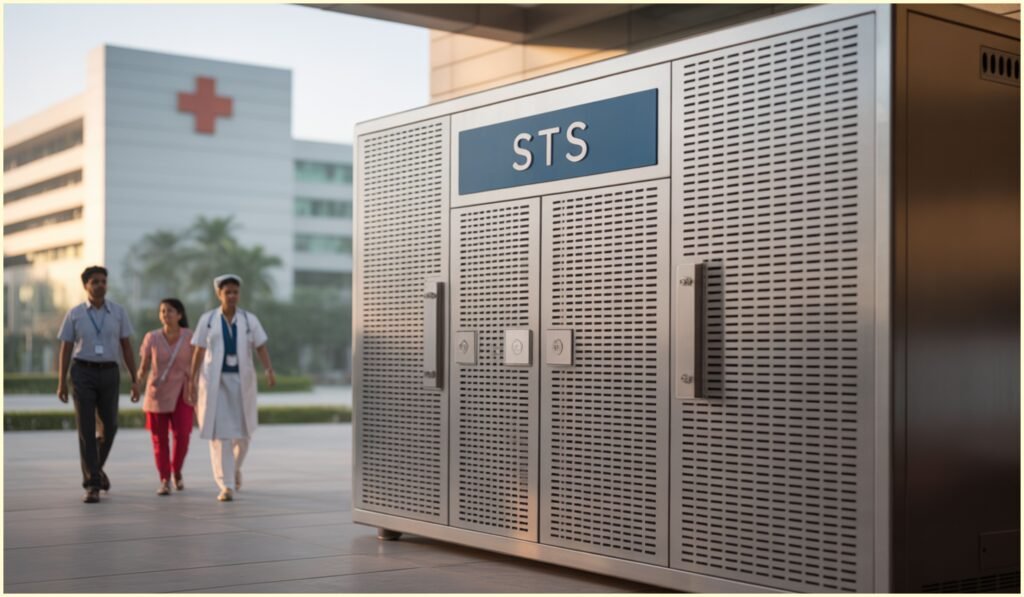
When we think of life saving or mission critical infrastructure, we picture advanced hospital equipment, humming data servers, aircraft radar towers, control rooms, or telecom networks connecting millions.
What we rarely think about is the one machine quietly powering them all—The Transformer.
Yet, in places where every second matters, transformers form the invisible backbone of uninterrupted power. They sit behind the walls, beneath the floors, inside substations silent, steady, and absolutely indispensable. Without them, even the world’s most advanced systems can collapse in a heartbeat.
As India modernises its hospitals, builds Tier-IV data centers, expands airports, upgrades defence communication networks and strengthens railway signalling, the demand for ultra-reliable, smart, and efficient transformers has never been greater.
When Power Fails at the Wrong Moment: A Scenario No Hospital Can Afford
Imagine an operating theatre in the middle of a complex cardiac surgery. The surgeon is deeply focused, the anesthetic team is monitoring vitals, and critical machines like ventilators, monitors, imaging devices, infusion pumps are running in perfect synchrony.
Suddenly, the transformer supplying the OT fails.
In that split second:
- Ventilators stop pushing air
- Heart-lung machines lose power
- Monitors flatline
- Lighting dims
- The surgical team freezes
Backup generators will start, but only after 8 to 12 seconds. In critical care, even three seconds of power loss can be catastrophic.
This is the harsh truth:
When a transformer fails in critical infrastructure, the consequences are not just financial, they can be fatal. This is why facilities such as hospitals, airports, data centers, defence bases, railway signalling cabins, and emergency operations centres must operate with transformers that simply do not fail.
Why Reliability Is Non-Negotiable in Critical Infrastructure
Critical infrastructure doesn’t sleep. It doesn’t pause. It doesn’t shut down for maintenance windows. Hospitals run 24/7. Data centers run 24/7. Defence communication systems run 24/7.
These systems cannot tolerate voltage dips, overloads, thermal stress, harmonic distortion, or sudden shutdowns. Transformers installed here require:
- High overload endurance, especially during emergency load surges
- Superior insulation and thermal stability for continuous operation
- Low loss cores to reduce heat and prolong life
- Minimal failure rates, tested for the toughest conditions
- Fire safe materials for sensitive areas like hospitals and control rooms
In these environments, transformers are expected not just to perform, but to protect and they must do it without error.
Why Critical Transformers Must Meet Stricter Standards
Transformers used in mission critical environments are engineered differently from standard industrial units. They must comply with enhanced reliability and endurance parameters:
- Higher dielectric strength
- Stronger mechanical bracing for short circuits
- Better cooling (ONAN/ONAF)
- Reinforced insulation systems
- Lowest possible losses (BEE/BIS compliant)
- Superior overload tolerance for emergency loads
- Fire resistant oils for sensitive indoor locations
Every component from the core to the bushings is designed with the understanding that a failure is not just undesirable, but unacceptable.
Smart Transformers: Predicting Failure Before It Happens
The future of critical infrastructure depends on predictive reliability, not reactive maintenance. Modern transformers equipped with IoT sensors, online monitoring, and AI analytics are changing the game. They monitor themselves in real time, much like a doctor checking a patient’s pulse.
These intelligent systems track:
- Temperature and hot-spot rise
- Oil levels and moisture
- Harmonics and load instability
- Vibration, noise, and core health
- Sudden load spikes
- Early insulation deterioration
If anything seems abnormal, the system sends an alert instantly. AI driven dashboards can predict failures days in advance, preventing shutdowns that would otherwise risk lives or millions of rupees worth of data. This shift from breakdown repair to predictive maintenance is transforming how India’s critical operations remain uninterrupted.
How STS Engineers Transformers for 24/7, Mission-Critical Performance
At STS we design transformers specifically for the rigorous demands of critical infrastructure. Our focus is simple but absolute: zero downtime, maximum safety, continuous reliability.
STS transformers offer:
High Reliability, Low Losses
Engineered with ultra low loss cores and robust insulation to minimise stress and guarantee long life.
Superior Overload Management
Built to sustain sudden surges, common in hospitals, airports, and data centers without overheating or tripping.
Smart IoT Monitoring
Real-time health dashboards, predictive analytics, oil & temperature monitoring, and SCADA ready systems ensure zero surprises.
Rugged, India Proof Design
Built to operate flawlessly in India’s heat, dust, humidity, voltage fluctuations and grid instability.
Critical Infrastructure Certification & Testing
Every transformer undergoes strict reliability testing to meet stringent safety requirements.
From hospital ICUs to Tier-IV data centers, from railway control hubs to military communication systems, STS ensures power that never fails, because some places cannot afford even a second of darkness.
The Silent Protector Behind Every Critical Operation
As India grows into a digital, high-speed, and technology driven nation, the importance of uninterrupted power becomes paramount. Lives, data, communication, safety, and national security depend on a transformer’s ability to remain stable every minute of every day.
And in this future where the grid becomes smarter, infrastructure becomes mission critical, and demands intensify STS transformer remains the silent guardian holding everything together.
With smart, tough, and sustainable engineering, STS ensures that India’s critical systems stay powered, protected, and prepared in all situations.